


In this space, we chat most things sleep, but I also love bringing in other experts in the parenting world to share their wisdom with us. And today I have someone here who I’m really excited about.
Michelle Pratt is a nationally certified Child Passenger Safety Technician (CPST) and mom of two, and she’s the founder of Safe in the Seat, the leading car seat safety platform for parents. I have been following her on Instagram for about seven years now and have learned so much, and I’m really excited for you to learn from her, too.
Introduce Yourself and How Safe in the Seat Came to Be
I’m Michelle Pratt, and I started Safe in the Seat for a couple of reasons, but primarily because I was the mom that thought I did the research, thought I had the best car seat because of what consumer reports said was the best car seat, and my mom told me it was the best car seat, because she researched, and did all the things.
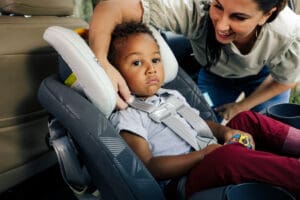
And then shortly after my son was born, we were going to get his newborn photos. And the photographer had worked with a lot of newborns and her studio was next to a boutique shop that sold car seats and they had certified technicians there. So she so kindly shared with me that there were a couple of critical things that I was missing when buckling my son in the car seat!
And when I think about how I felt in that moment, it still kind of gets me choked up a little bit, honestly, because I started Safe in the Seat to take that feeling away from everyone – the, “I wish I would have known, why didn’t I know?”, feeling.
Of course I would never purposely put my baby at risk. So then I started looking for more resources – I just wanted someone to tell me in a way that I could understand and implement and execute and feel great about. But I couldn’t find that resource.
And I was at a time in my life where I was on the verge of a divorce. I was going to need to start kind of figuring out what was going to happen from there. I had already put Safe in the Seat on Instagram, but I hadn’t really launched it as a business; I was just trying to figure out, do other people feel the same way I do?
And sure enough, there are a lot of people who felt the way I did in that moment when I heard of some of the corrections that I needed to make. Or even just in the panic moment of leaving the hospital, being like, “What do you mean no one’s gonna help me do this? I did not prepare for that. It’s installed, I did the base thing I’m supposed to do in the car. But like, what do you mean, you’re not gonna put him in there?”
I really started Safe the Seat to take all of those moments away.
So I hope now that people come to us from the beginning, so they never even have to know that feeling. They never even have to experience what many of us have experienced.
Our team wants you to feel empowered to know exactly what to do with your car seats and then move on to the next thing.
Car seat safety doesn’t have to be something that lingers over your head.
We’re going help you get it right, and then it’s right. Our job is to get you the information you need about car seats and to get you to feel confident about it.
What are the most common car seat mistakes you see?
Our biggest concern nationwide is that people don’t use a car seat at all.
Moving to the next car seat stage too soon
But once we’re all on the same page, that our kids need to be in a car seat or booster, the next most common mistake is moving from one car seat stage to the next too soon. We see a lot of kids that are just in the next level stage and they shouldn’t be there yet.
Moving too soon at every level that you go up is a different level of safety. Especially when you switch from a harness to a booster stage, that switch is taking responsibility from you as a parent and putting it onto the kids, because now they have to sit properly the whole time you drive.
And the law is nowhere near caught up in many, many states to what is the safest for our kids.
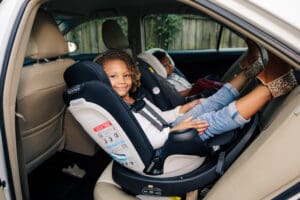
The rear-facing to forward-facing transition
In most states, the law requires children under the age of two to be in a rear-facing car seat, however safety-wise, age two is way too young to transition to a forward-facing car seat!
The car seat +harness to booster transition
Many families transition their kids from a car seat (with a harness) to a booster seat when their child goes to kindergarten. But again, safety-wise, five and six-year-olds should not be in a car without any car seat or booster!
The booster to nothing transition
The age range for when kids are ready to transition from a booster seat to no seat in the car is actually one of the highest risk age ranges, because putting them in a car without any seat is like putting them in there as an adult. Vehicles are crash-tested with adults.
So when we put an eight-year-old in the vehicle without a booster and that vehicle seatbelt does not fit them properly, we can’t expect it to do what it’s supposed to do because it’s not crash-tested to fit that way.
My 95th percentile almost 10-year-old is still in a no-back booster because she still does not fit the requirements to stop using one.
My almost 13-year-old just got out of one when he was about 11.5 years old. And yes, he was talking about how ridiculous he felt or how his friends didn’t have to sit on anything. And I’m like, “Listen, dude, I care about you a whole lot. I never want anything to happen to you. So when you’re in the car, you’re going to be sitting in something.”
And they have lower profile boosters that you can get as kids get older so it’s not as much of a thing. ⁓
Not reading the car seat manual
Another big mistake we see is that people don’t read the manual! that can be way up there because that’s up there. Yes, they are confusing and it’s overwhelming, but it’s required. It’s a big part of why we try to like take some of information and break it down and make it simpler.
Tightness of the car seat and harness
Another common mistake is the tightness of the car seat and the tightness of the harness – it’s critical. And this is how I explain it big picture…
When we’re using a car seat, we’re essentially retrofitting vehicles to allow the transport of children. We’re literally adding a piece of equipment to a vehicle to now be able to have that vehicle transport children. That vehicle is not designed by itself to transport children. So we have to add this device so that we can do it safely.
So if you think about that, secure car seat attachment makes a lot of sense. We want it to feel like it fits like a glove with the car seat. We need it to be in there good and tight because again, we’re retrofitting that vehicle to now safely transport a child.
And the more movement that car seat has translates to movement for the child, which is then where we come in – that tight harness really matters. Less movement, less injury, period, end of story.
Now, we don’t have to be crazy about it. We don’t have to be pulling that thing so tight that we feel like our babies are not breathing. We just need to do it at the right level (“to the pinch test“), but it shouldn’t be loose. Anytime your child is in a harness, you should not be able to move their body up and down or side to side with space. A lot of us miss that slack around the legs – I certainly did when I first started out!
And many more!
There are also more specifics that we often help families correct, like making sure that the car seat is tightly installed in the vehicle (you shouldn’t be able to move it more than an inch when you check it out at the belt path).
We also have to think about things like recline (especially for newborns!), and attaching the top tether. These are the things we see most frequently missed!
An analogy I like to use is cooking versus baking. When I’m cooking dinner, I can add a little bit of this and a little bit of that. When I’m baking, I have to be exact to get the end result that I want. Car seat installation and use is like baking. When we follow the car seat manual precisely, the outcome is going to be what we want it to be, which is survival in the event of a car crash.
Car seats are extremely safe when used properly – they save so many lives.
Many people obsess over buying the “right car seat,” but then we don’t obsess over making sure we know how to use it. And the car seat is only as safe as it’s properly installed and your child is properly harnessed.
Yes, different car seats have different features (i.e. different fabrics, harness pads, cup holders, etc.), but features do not impact the safety of your child in the car seat.
At Safe in the Seat, we try to help people understand that choosing the car seat is the easier part, and we try to help make it even easier for people. Using it correctly is what makes a car seat safe.
And once you know how to safely use a car seat, then the system is the same. The way you harness remains the same, so now you’re adjusting a crotch buckle, or you’re raising a shoulder strap. We have to make changes as they grow, but it’s not hard.
You are a great mom no matter how much you know about car seats. Our ultimate goal is that every parent can shut that door once they’ve buckled their kid in, and they’ll know that if anything happens on that drive, they did everything they could to keep their child safe.
We can’t control what’s happening externally from our car – crashes happen all the time that we can’t control. And I don’t ever want parents to be sitting on the other side of a crash thinking, “Why didn’t I know that? Why didn’t I do that? Why didn’t anyone tell me that the harness needed to be tighter?”
What is or isn’t safe with car seats and sleep?
Neck Control
I think when we’re thinking about the stages of car seat safety, there’s a very big differentiator in sleep, and that is kids with neck control versus kids without neck control.
When our babies are born, we are their support system. We are the only ones who can hold them in place – their bones aren’t fused and their muscles aren’t fully formed, so they can’t lift their head up.
Around six months, they will start to be able to sit up and hold their head up independently, and that is a big differentiator in sleep and car seats.
0-6 months
So when they’re 0-6 months, when they don’t have full neck control, the car seat is not flat. And we know that babies are supposed to be flat when they sleep. The car seat is reclined because that’s how it performs in a crash; it needs to be at that angle to best perform in a car crash.
So as a result, because the baby is not flat to sleep, the car seat has to be at the proper recline to make sure we can keep their head back. We do not ever want a child without neck control to have their head falling forward, as that can quickly block their airway.
In order to prevent their head from falling forward, we have to keep the car seat at the recline that it’s supposed to be at and we have to keep that harness tight because we don’t want the baby slipping or moving around in any way that could shift their body.
I have found that newborn parents are often nervous about a tight harness. But please make sure the harness is tight and that their car seat is properly reclined, so you know your baby is safe.
6+ months
Once babies have full neck control, around 6+ months, then you still need to care about recline, you still need to care about a tight harness, and you still need to care about proper installation. But you can be less worried about that neck or head falling forward, because now if it happens, the baby can lift their own head up and move it into a different position, if needed.
Parents often come to us nervous that their child’s head keeps falling forward or to the side when they’re asleep in their car seat, so they try to add things to hold their head up. Please don’t do this, it’s not safe!
As long as your child is developmentally aligned with where other kids their age are, then there should not be a concern. If they’re uncomfortable, they’ll pick their head up in order to adjust themself to make sure their airway is open (just like you or I would do on an airplane!).
Car Seats are not Sleep Devices
Car seats are not sleep devices – they are transportation and vehicle devices. So unless you’re driving, it’s not ideal for your baby to be asleep in their car seat for excessive periods of time. The car seats are designed to be safe in the vehicle (think recline, specifically!), not outside of the vehicle.
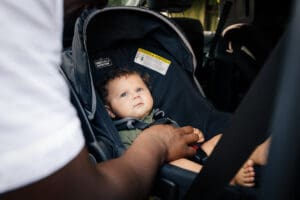
For babies who still don’t have neck control, when they’re in the car seat for any reason, we want eyes on them. When you’re driving, you of course can’t have eyes on them, but make sure you’ve done the steps to make sure they’re safe – proper recline, tight harness, and safe installation.
If they fall asleep in their car seat when it’s attached to their stroller, that’s okay for limited periods of time. It’s designed to be at the proper recline, so you can keep your baby fully and tightly harnessed and they’re safe.
If you’re at the grocery store, make sure the car seat is in the big part of the cart, with the handle down to stabilize it. But again, for those without neck control, make sure they are facing you if they’re in the stroller or shopping cart, so you can see them at all times – there should be nothing blocking your line of sight to them, including a car seat cover.
And it should be your goal to transfer your baby out of their car seat any time that they are not in the car or in a stroller.
Here are some things you should NOT do when your baby is asleep in their car seat:
- Never unbuckle your baby and leave them in their car seat!
- Do not leave them in a car seat outside of the car for a long period of time.
- Never place your baby’s car seat on an elevated surface, even if they’re fully buckled in.
Now I’m a realist and a mom of two, and I had one baby that never slept! So sometimes when I got him in his car seat and he would actually sleep for a little bit and wouldn’t be screaming, it was the best five minutes I had had in weeks! I understand the realness and comfort of car seats and sleep.
Across the board, if an infant is in a car seat and you’re carrying it in and out of the car, your eyes should be on them in some capacity. Now let’s say you’re somewhere like church and your baby is sound asleep in their car seat…
Car seat safety says you should take your baby out of the car seat. But let’s say baby is asleep and you also have a toddler you’re trying to manage and now managing two kids feels like too much, you can keep your baby in the car seat for a bit. Make sure you put the handle down to stabilize it so it’s not rocking, keep the harness fully buckled, and make sure your baby is facing you and you can see them – do not cover where you can’t see them.
Would I like you to take the baby out of the seat and you hold them? Yes. But I know real life happens sometimes, so I really try to bring to people the realistic point of view. Yes, I would like you to take the baby out of the car seat. But I’m also a real mom who gets it, so in these scenarios, we do the next best thing/the next safest thing that we can do. So just think eyes on the child, fully tightly buckled, facing you, and you’re in good shape.
If we see another parent using a car seat incorrectly, how do you recommend we tell them it’s unsafe?
Most people prefer not to give unsolicited advice, but when we see something that is unsafe for kiddos, it’s natural to want to say something! I think the difference between solicited and unsolicited advice here happens when we enter the conversation by asking.
So it’s really saying, “Hey, I’ve noticed something that could help keep your child even safer in their car seat. Are you open to me sharing it with you?” And they say, “Yeah, what? My gosh, yes.” Or they say, “No, thank you.”
The, “No, thank you,” is going to hit your gut a little bit because you know that there’s something that could and should be adjusted. So in those situations, I’d of course like you to slip something in like, “Okay. I just want to let you know that I follow Safe in the Seat on Instagram and she’s a great account to follow for car seat stuff.”
That at least throws out a potential resource for that mom to come back to if she starts wondering what she could do to keep her kids more safe in the car.
But if ultimately they don’t want the advice, you don’t give the advice.

What resources does Safe in the Seat have for parents?
The majority of our help and our best resources can be found on our website.
The Blog
Our blog will answer every single question you could possibly have about car seats, and it’s all there for free! You’ll have to sift through a lot of content to find what you’re looking for, but it’s all there.
One-on-One Support
If you need more help, we have one-on-one tech support, so you can just pay for a one-time question. And I would like to tell you that we follow our own rules and only reply back once, but my team is amazing and they go above and beyond. But with this option, we can look at your setup, we can help you at the hospital, for example, and we reply within 24 hours. So that’s a really great resource.
We also have full-blown video consults where we can do everything with you in real time. You can learn more about our one-on-one support options here.
Airplane Travel Guide
We also have our airplane travel guide, Safe in the Sky, that helps you learn how use car seats on the airplane, as well as how to travel with car seats so they don’t get damaged.
Car Seat Journey Guide
A resource we launched last year is Conquering the Car Seat Journey, for ages 0-13.
It’s a reference guide for that tells you everything that you need to know about the car seat transitions. We’ve even included things behaviorally you need to be prepared for and how to handle them as those situations come up – just real-life mom stuff in there.
So that’s a digital resource for people and you always get the updates on it if and when we make them.
Car Seat Finder Tool
Finally, the tool that we are probably best known for right now is the Car Seat Finder Tool (free!). It is a regularly updated resource where you answer questions that then takes the hundreds of car seats in your category and filters it down to the handful that are the best for you.
These questions range from your budget to your vehicle compatibility issues to needs and wants (i.e. a flame-retardant-free cover). And then we get to know a little bit about your child’s body type to be able to direct you on the right path. We take a lot of pride and responsibility in those recommendations, as it’s all powered by hands-on experiences with each of the car seat recommendations.
And it’s a free resource! We truly want to make things as easy as possible for people. If you don’t want to dig into all the research, you shouldn’t have to. We are the experts in this area and are telling you what you need to know without you having to spend your precious time on figuring it out yourself.
Is there anything else you’d like to share?
I started Safe in the Seat with no followers and I had no idea what I was doing. And now we’re here and we’re impacting so many people every day, and I feel a tremendous responsibility and a great privilege to be doing this kind of work.
The final advice I want to leave you with is that it’s really important that when you are getting advice or taking recommendations about anything, that it’s coming from a qualified source; it’s coming from someone that’s certified in the area. And I think in this day and age with AI and with influencers, it can be easy to say, “This influencer has that car seat and I really like her and her style.”
And then you get it, but it’s not the best car seat for you. Or you ask ChatGPT about the best travel car seats, and it’s not a complete picture! AI has never put their hands on these seats. of the travel seats and AI certainly hasn’t ever put their hands on the seats.
It’s just really important to take a pause for any type of information, and when it comes to things like sleep or safety, who you’re getting the information from is really important.
About Michelle Pratt

Michelle Pratt is a nationally certified Child Passenger Safety Technician (CPST) and mom of two, best known as the founder of Safe in the Seat, the leading car seat safety platform for parents. With a trusted, judgment-free voice, Michelle helps overwhelmed families cut through the confusion and feel confident about car seat safety. Through her free car seat finder tool, online courses, and consultations, as well as daily safety tips and videos, she’s empowering caregivers everywhere to keep their most precious cargo safe in the car seat.