


I want to start by saying twin and triplet life is hard. So rewarding, so beautiful, such a gift, but HARD! I don’t have twins or triplets myself, but as a mom of four, I can only imagine what it’s like to have two or three kiddos in the same stage at the same time.
I don’t love comparison and saying one person has it harder than the other, but twin parents, you do. Two newborns at one time is hard. Three toddlers at one time is hard. Multiple kiddos going through puberty at the same time is rough!
When we have twin or triplet families come to us, they’re usually more tired than other parents coming to us, and are often more overwhelmed. That’s not to belittle how tired and overwhelmed singleton parents are, but think about it…
So all of this to say, twin parents, triplet parents, parents of multiples – what a gift you have, and also we see you and know it’s hard.
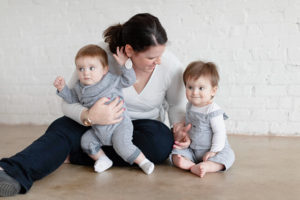
And then let’s talk about a baby or toddler who isn’t sleeping. One baby not sleeping well is hard. One toddler getting out of bed at night is hard. But two babies who need to be rocked or fed to sleep? Whew! Two toddlers who are awake and chatting for an hour or two in the middle of the night? Ahhhh! Not to mention if you have other kiddos to care for and get to bed, too!
So in this post, we’re going to talk about sleep training twins and triplets. (I’m mostly going to say twins, for the sake of ease. But triplet parents, this counts for you, too!)
When it comes to sleep training, in one sense, sure, you can say sleep training twins is the same as sleep training a singleton. And in some ways, sure, it absolutely is – similar methods and routines. But also, doing it with two kids at the same time is not the same as doing it with one kiddo.
So we’re now going to dig into the reality of sleep training twins and triplets, including:
- Safe sleep and how we chat about that with twin families
- A realistic bedtime routine for twins
- How we determine if twins should share a room or have separate rooms
- Adjusted age and how to keep your twins on the same sleep schedule
- How sleep training twins looks different at different ages
- How to approach night feeds with twins
And more!
Safe Sleep for Twins
I chat all about safe sleep for babies in this post and safe sleep for toddlers in this post, so definitely go check those out for all the nitty gritty. And all of those safe sleep rules for babies and toddlers count for your twins!
So now I just want to share some of the twin or triplet-specific safe sleep issues that don’t usually come up when talking to singleton families.
Your twins should have their own cribs
Your twins should not be sharing a bassinet, crib, or pack ‘n play – they each need their own space!
Avoid “bottle propping”
Whether your twins are getting a bottle while they’re awake, or if they’re drinking a bottle to go to sleep, their bottle should not be propped by any pillow, blanket, or obejct. This isn’t safe because that propping means milk is continuously flowing, and if your babies try to pause, or need to cough, or burp, that bottle propping can get unsafe.
I know it’s tough to feed two babies, so rather than bottle propping, we recommend using a twin feeding pillow while you hold the bottles, or two bouncers, or even lay your twins on their sides on the floor as you hold the bottles.
Your babies should not be sleeping on a Twin Z pillow
Just like it’s not safe for a baby to sleep in a SnuggleMe or DocATot or Boppy pillow, it’s not safe for twins to sleep on a Twin Z pillow!
Now I get it. You’re in survival mode and these “no’s” I just listed might be the only things you have found that kind of work. And I hear you!
We find that twin parents often reach their breaking point sooner than other parents, and it makes total sense. AND I have to share that those things just aren’t safe for your babies. So if you’re currently doing one or more of those and want to stop but don’t know how, please reach out! This might be a great time for some sleep training. The result will be safe and consistent sleep.
A Realistic Bedtime Routine for Twins
First, here is a blog post that goes into all of the details of our recommended order of a bedtime routine for babies and toddlers, and I recommend the same order for twins and triplets.
However, when you have two babies or toddlers at a time, that changes things!
So a fellow sleep consultant and twin mama shared some bedtime routine tips with me a few years ago. One, she said that bedtime routines with twins always feels like an assembly line. Can you relate?
Here’s her encouragement and recommendations to help you manage the routine as smoothly as possible…
Expect 30-45 minutes
With singleton babies, we often suggest their bedtime routine be around 20-30 minutes long. But with twins or triplets, expect more like 30-45 minutes, as everything takes longer with multiples!
Prepare and lay out everything ahead of time
My friend also recommends you lay everything out ahead of time so you’re not scrambling through drawers for towels, jammies, or sleep sacks. And if you’re bottle feeding, have getting those bottles ready as part of this preparation.
Use a bouncy chair for the twin not bathing
If it’s bath night, have a bouncy chair in the bathroom with you so you can bathe one baby while the other is close by, and then switch! This makes it especially possible to do bedtime duty solo.
Close the nursery door
Once your babies are mobile, make sure the nursery is baby-proofed, of course, and then close the nursery door during the bedtime routine so your twins can’t get out.
Alternate who you lay down first
My friend also said that at the end of the bedtime routine, she recommends alternating which twin is laid down first, so as they get older there’s no feeling of competition. So on Monday night if you put Twin A in their crib first and then Twin B, on Tuesday night put Twin B down first and then Twin A.
These simple routines can make a huge difference in the long run!
You can do the bedtime routine solo!
Finally, she taught me to really encourage twin parents that you can do bedtime on your own. Yes, it feels so much easier when mom and dad can tag team, and by all means, tag team! But also, know that you CAN do it yourself!
Dad can go watch the game at his buddy’s house and mom can absolutely handle a solo bedtime. Mom can go for a walk in the evening and dad can absolutely put the babies to bed on his own! And it feels so freeing when you reach this spot, so fight for it!
Sleep Training Methods for Twins
I explain the four sleep training methods in this post, and share that at Via Graces we use the chair method and leave and check.
And when it comes to sleep training twins, you can also use the chair method or leave and check!
If parents are comfortable, we generally lean toward leave and check when sleep training twins, as there’s already so much going on in that room, so adding another body can make it even more overwhelming – both for the babies and the parents!
With leave and check, you can either have one parent do all of the check-ins for that nap or bedtime, or parents can alternate! That’s really up to you.
However, the chair method absolutely works when sleep training twins, too! If this makes the parents feel more comfortable, or they think it would help the twins more, we can absolutely start there and see how they do.
And twin parents can do just one parent in the room or both parents, one on each baby. We recommend just one parent, mostly for the sake of letting the other parent have a break and to also be ready to swap, if necessary. But I’ve had some families where both parents really want to be in there together, and as long as it works for the babies, and of course, the parents, it works for me!
And if you’re sleep training twin toddlers or older kids, we most often start with the chair method and then finish off with leave and check.
When it comes to choosing the sleep training method that’s best for your twins, what’s most important is that you can do it consistently! This is what will help your babies and toddlers catch on the quickest.
It’s also important that parents take turns putting the babies or toddlers to bed, to some extent. Whether it’s literally every other day or every couple of days, for your twins to know whether it’s mom or dad doing bedtime, that the result will be the same, is really important.
I also have to say, no matter which sleep training method you choose, your twins will wake each other up. Whether that means Twin A falls asleep first but then five minutes later they wake up again because Twin B is still crying. Or if that means Twin A wakes up at 1 am and consequently wakes up a snoozing Twin B.
It will happen with twins sharing a room. It’s just part of life with twins, and par for the course when sleep training twins, and they will figure it out. And it’s a skill they will need while room sharing, so yes, it’s frustrating, but it won’t last forever.
Should twins share a room or sleep in separate rooms?
There’s not a right or wrong answer here, but we always encourage families to start where you want to end – and this certainly is the case when sleep training twins!
If you want your twins to room share for the next 3+ years, sleep train them in the same room! If we get a week or two into the plan and one twin is still really struggling with naps, we might split them up for naps for 2-3 days, but that’s really not the norm.
Oppositely, if you have separate nurseries set up for them but you’ve had them both in your room, or in the same room for the sake of ease with all of these wake-ups, sleep training would be the time to put them in their own rooms if that’s your end goal!
Finally, I’ll slide in room sharing with you, the parents! We give the same advice here – start where you want to end.
If you plan to keep your babies in your room for a few more months, keep room sharing! But if your plan is to move your twins to their nursery as soon as they only wake up once a night, or sleep through, do that now, as you begin sleep training – start where you want to end!
How to Keep Twins on the Same Sleep Schedule
Now let’s talk about how sleep training twins or triplets changes based on their age. And by age, we’re talking adjusted age, so their wake windows might be slightly shorter than other babies their age, simply based on their adjusted age and development.

Sleep Training Twins 4-6 Months Old
If your twins are between 4-6 months old, and on a three (or four) nap schedule, we recommend the 20-minute rule: try to keep your twins’ sleep schedules in sync as much as possible, allowing 20 minutes of wiggle room, as necessary.
So if Twin A wakes up from a short nap and Twin B is still sleeping, you can let Twin B sleep for 20 more minutes, but then go ahead and wake them up so their schedules stay in sync.
And then when thinking about their next nap, you’ll split the difference. So let’s say you have 5-month-old twins and their afternoon wake window is 2 hours and 15 minutes. And Twin A wakes up from their morning nap at 10 and you wake Twin B up at 10:20. Two hours and 15 minutes from 10 would be 12:15, but 2 hours and 15 minutes from 10:20 is 12:35. So splitting the difference in this case would mean putting them down for their second nap at 12:25.
Make sense?
Now once your twins are on a two-nap schedule, which usually happens around 7 months old (sometimes closer to 8 months old for twins), now we move to a set, clock-based schedule, just like singletons. And I talk all about this schedule in this post.
When on a clock schedule, we really try to stick to that schedule as much as possible! So if Twin A only naps from 9:30-10:15 but Twin B naps from 9:30-11, you’re still aiming for that 2 pm nap for both babies, because that’s the two-nap schedule. You’re no longer using that 20-minute rule here.
Now, when it comes to sleep training twins, “the squeaky wheel gets the grease.” If, in the scenario above, Twin A took a short nap and you’re aiming for that 2 pm nap, but they are just struggling to get there, you might have to put them down closer to 1:45, which yes, might be a few minutes too early for Twin B.
But if one twin needs a change, you essentially think about who needs it more and they’re both going to adjust accordingly.
What we don’t want to happen is your twins each have their own feeding and sleep schedules, because that will make you crazy! It might sound great in theory, they’re both getting exactly what they need or want, but what about you? Big picture, it’s the most simple (although not so simple!) to keep your twins on the same sleep schedule.
This even goes for night feeds, so let’s transition there!
How to Handle Night Feeds with Twins
When I first became a sleep consultant, I thought that if Twin A wakes up to eat but Twin B is still sleeping, let Twin B keep sleeping and just feed Twin A! And then if Twin B wakes up to eat but Twin A is still sleeping, just feed Twin B – let them tell you what they each need.
But then I actually started working with families and learned, and I no longer recommend just feeding the baby that wakes up. Because the result is mom and dad who are up all night long, bopping back and forth between babies!
So now we tell our twin families that if one baby wakes to eat in the night, wake the other and feed them, too.
Yes, it’s always a bummer to wake a sleeping baby, I get it! But I’d much rather you wake your sleeping baby and feed them than have to wake up again an hour after feeding Twin A to now feed Twin B. Because your sleep is so so important!
Keep Your Sleep Goals Realisitc for Your Twins
My last suggestion, or more encouragement, when it comes to sleep training twins is to keep your goals realistic.
Sleep training two babies or two toddlers is harder than sleep training one! Our baby sleep training plans are generally two weeks long, but it’s not uncommon for twins to need a third week, or for twin parents to not totally feel confident until the third week.
Same for toddlers who are generally on a three week plan. Sometimes it takes closer to four weeks to get into a place of consistency with twin toddlers.
And it makes sense, you have two kiddos waking the other, or learning behaviors from the other, so it’s just going to take longer.
Remember we’re focusing on progress over perfection, and these sleepless nights won’t last forever.
Conclusion
The goal of this post is to speak to parents of multiples and to make sleep training twins feel more doable, or to understand it more.
Because yes, like I said before, sleep training a singleton and sleep training twins looks very similar on the outside, but there just are going to be differences! The bedtime routine will naturally look different, how you approach night wakings, and how you keep their schedules synced up is just going to be different than if you only had one baby.
So my hope is to help you see how sleep training is possible for you, too, and break down some of those “but twins” barriers.
Also remember that having twins or triplets is so beautiful, and so hard. And enduring sleepless nights with twins or triplets is so, so hard. You might still be in the thick of newborn land where sleep training isn’t possible yet, and if that’s you, you’re doing a great job! You can’t sleep train yet, but the time will come.
And if you’re reading this as a parent of multiples and you’re like okay, it’s time to sleep train these twins or triplets, or it’s time to sleep train these toddlers, but man, it just all feels like too much, know that we are here for you! And we’d love to personalize a plan for your sweet kiddos and your family and help you all get the best sleep possible!
And guess what?? Here at Via Graces, we don’t charge you for two babies or two toddlers, because you have to pay double for everything else. Well, not here! So if you’d like to learn more about what it looks like to work with someone on our team to sleep train your twins, look here!
Or book a (free) discovery call so you can ask us more about the process.
With Grace,
Lauren
Note that this blog contains an affiliate link.